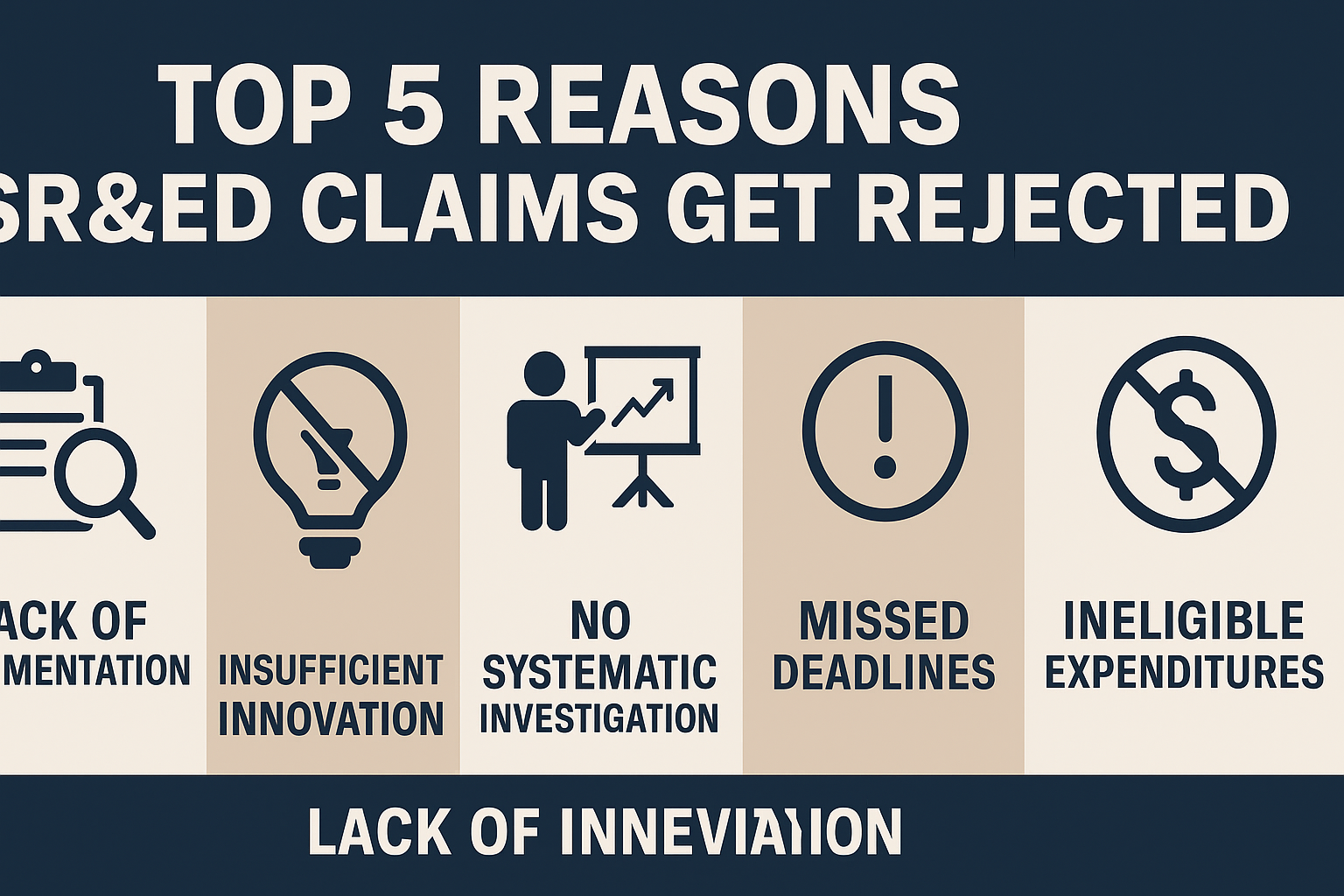
Scientific Research & Experimental Development (SR&ED) tax credits are one of Canada’s most significant incentives for businesses engaged in innovation. While the program offers substantial benefits, a surprising number of SR&ED claims are rejected each year due to errors, oversights, or non-compliance. Understanding why these claims fail is essential to improving your chances of approval and maximizing your refunds.
Below are the top five reasons SR&ED claims get rejected, along with actionable strategies to avoid these pitfalls.
1. Inadequate Documentation and Poor Record-Keeping
One of the primary reasons the Canada Revenue Agency (CRA) rejects SR&ED claims is insufficient documentation. Businesses often fail to maintain detailed records of their research activities, making it impossible to substantiate the claim during a review or audit.
Why Documentation Matters
The CRA requires clear evidence of the scientific or technological uncertainties, hypotheses, experiments, and results involved in your project. Without detailed contemporaneous records, the CRA may view your work as routine development rather than qualifying R&D.
How to Fix This Issue
- Keep daily logs, experiment notes, prototypes, test results, and time tracking for all employees involved.
- Implement structured SR&ED recordkeeping systems, as outlined in our guide on the importance of keeping detailed SR&ED project records.
- Document every phase of your project: uncertainty, experimentation, iteration, and results.
For an in-depth overview of how to document your R&D work effectively, check the CRA’s official SR&ED documentation guidelines.
2. Lack of Technological or Scientific Advancement
Another frequent cause of rejection is that the project does not meet the SR&ED definition of “advancement”. Many businesses mistake routine engineering, software development, or product improvement for qualifying work.
Understanding SR&ED Advancement
The CRA defines SR&ED as work aimed at achieving technological or scientific advancement through the resolution of uncertainty. If your project simply involves using existing technology, processes, or knowledge without pushing boundaries, it is unlikely to qualify.
How to Ensure Eligibility
- Demonstrate that your project sought to overcome a technological uncertainty that could not be resolved by standard practices.
- Present supporting evidence through technical narratives that detail the challenge and how your R&D went beyond existing knowledge.
- Refer to our guide on who qualifies for SR&ED to ensure your project truly meets the CRA’s eligibility standards.
Additionally, understanding the difference between SR&ED tax credits and grants can help businesses position their projects strategically (compare SR&ED credits vs grants).
3. Incorrect or Incomplete Financial Data
SR&ED claims often get rejected due to errors in financial reporting. Claimants may miscalculate eligible expenses, include non-qualifying costs, or fail to properly segregate R&D costs from general operating expenses.
Common Financial Mistakes
- Including marketing, administrative, or sales-related costs as SR&ED expenses.
- Failing to allocate wages and contractor fees properly.
- Overstating capital expenditures or equipment costs.
How to Avoid Rejection
- Use a specialized SR&ED consultant or accountant who understands the intricate financial rules (hire an experienced SR&ED consultant).
- Maintain accurate cost allocation systems to track eligible expenditures separately.
- Leverage our SR&ED calculator to estimate your refund accurately before filing.
For official definitions of eligible expenditures, review the CRA’s SR&ED financial guidelines.
4. Poorly Written Technical Narratives
Even when a project is eligible, a weak or vague technical narrative can lead to rejection. The CRA relies heavily on the project description to determine if your work involves qualifying SR&ED.
What Makes a Narrative Fail
- Using overly generic or marketing-focused language instead of technical detail.
- Failing to clearly explain the scientific uncertainty and experimentation process.
- Omitting how your project contributed to technological advancement.
How to Improve Technical Narratives
- Focus on the problem, uncertainty, experimentation, and results, using technical language that addresses the CRA’s criteria.
- Avoid jargon unrelated to the scientific or engineering challenge.
- See our full step-by-step SR&ED claim process guide for tips on crafting strong narratives that withstand CRA scrutiny.
5. Filing Late or Missing Deadlines
SR&ED claims have strict filing deadlines, and missing the 18-month window from the end of the fiscal year will automatically disqualify your claim, regardless of eligibility.
Filing Rules You Need to Know
- Claims must be filed within 18 months of the end of your company’s tax year.
- Late claims are not accepted, even with valid reasons.
Strategies to Stay on Track
- Work with a SR&ED tax credit specialist to ensure your claims are prepared and filed on time.
- Consider SR&ED financing options to improve cash flow and avoid last-minute delays.
For authoritative details, consult the CRA’s official SR&ED deadlines page.
Conclusion: Maximize Your Refund by Avoiding These Pitfalls
Most SR&ED claim rejections are avoidable. By maintaining meticulous records, ensuring true technological advancement, preparing accurate financials, crafting strong narratives, and filing on time, businesses can significantly increase their chances of approval.
For businesses seeking guidance, our team offers specialized consulting, financing, and tax credit advisory services to help you maximize your returns. Visit our contact page today to connect with a SR&ED expert.
