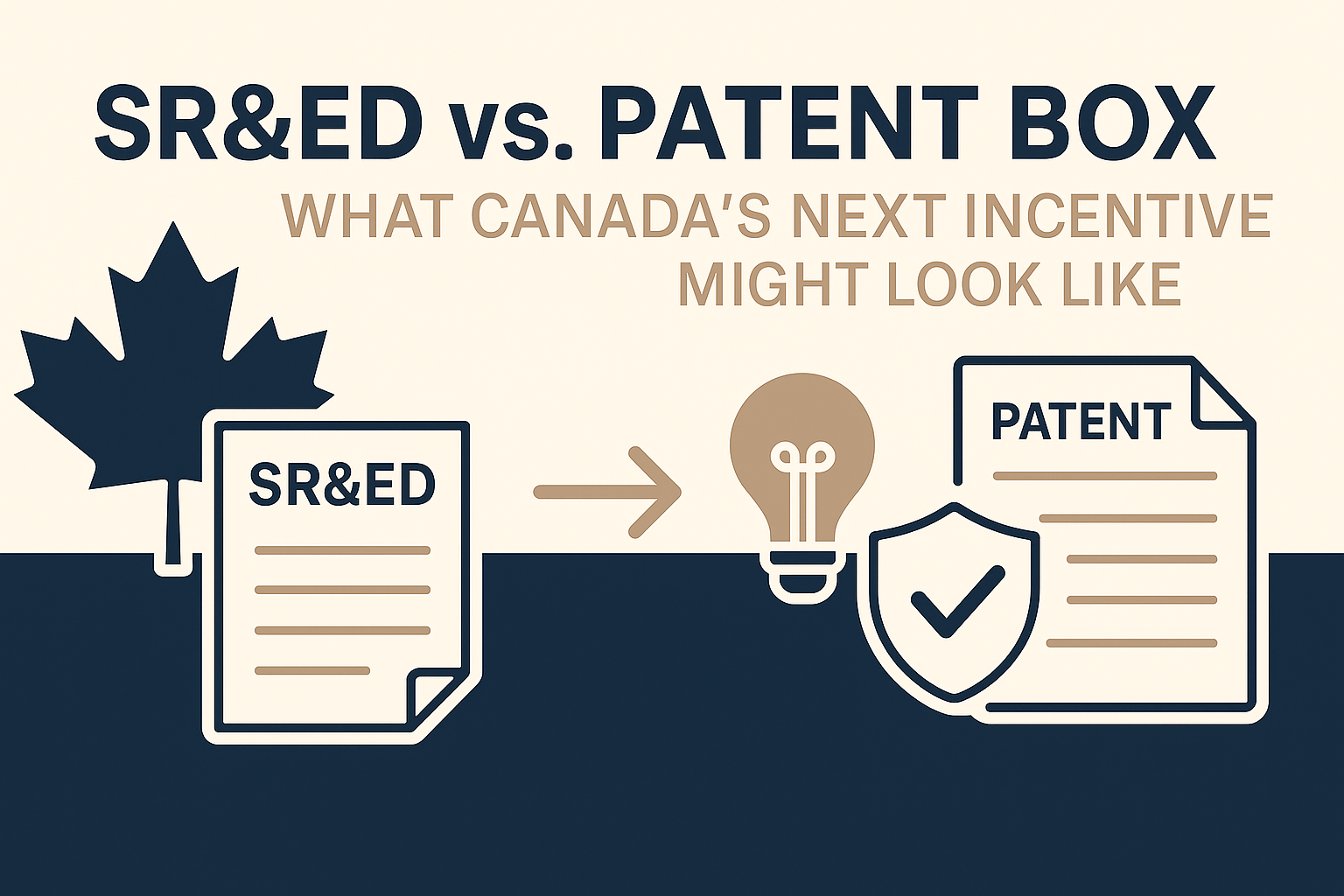
Innovation drives economic growth, and Canada has long relied on the Scientific Research and Experimental Development (SR&ED) tax credit program to encourage companies to invest in research and development. At the same time, other countries—especially in Europe—have introduced Patent Box regimes, which reduce corporate tax rates on income derived from intellectual property (IP). With global competition intensifying, many Canadian businesses are wondering whether the government might adopt a Patent Box model or adapt SR&ED to remain globally competitive.
This article explores the differences between SR&ED and Patent Box, what lessons Canada can take from international jurisdictions, and what the future of Canadian innovation incentives might look like.
What Is the SR&ED Program?
The SR&ED tax credit is Canada’s cornerstone R&D incentive. It allows companies to receive cash refunds or tax credits for eligible R&D expenditures. These include wages, materials, and overhead costs tied directly to experimentation and innovation.
For businesses, SR&ED funding is essential because it:
- Encourages risk-taking in scientific and technological projects.
- Provides predictable funding tied to actual R&D expenses.
- Supports a broad range of industries, from software and IT projects to manufacturing and clean technology.
Companies exploring SR&ED often begin by assessing whether their projects meet eligibility requirements such as scientific uncertainty, systematic investigation, and technological advancement. For more detailed criteria, you can review SR&ED eligibility guidelines.
What Is a Patent Box Regime?
Unlike SR&ED, which funds R&D inputs (i.e., expenses), a Patent Box rewards outputs—profits derived from patented or IP-protected innovations.
Under a Patent Box system:
- Businesses pay a reduced corporate tax rate on qualifying income tied to IP, such as patents, copyrighted software, or proprietary processes.
- The incentive only applies after IP has been developed and commercialized.
- Many European Union members, the U.K., and even some Asian economies have already adopted Patent Box policies.
This creates a direct link between commercialization success and reduced taxation, providing strong motivation to retain IP in domestic jurisdictions rather than shifting it offshore.
Key Differences Between SR&ED and Patent Box
1. Timing of Benefits
- SR&ED: Immediate relief during R&D, often before commercialization.
- Patent Box: Rewards are realized only after commercialization and profitability.
2. Risk Mitigation
- SR&ED: Helps offset upfront risks of R&D investment.
- Patent Box: Encourages companies to retain IP domestically but doesn’t reduce the initial cost of innovation.
3. Scope of Industries
- SR&ED: Broad, supporting experimental development in diverse fields.
- Patent Box: Typically narrower, applying to IP-heavy industries such as biotech, pharmaceuticals, and software.
4. Economic Strategy
- SR&ED: Stimulates activity within Canada’s R&D ecosystem.
- Patent Box: Aims to prevent IP migration and ensure Canadian-developed patents remain in Canada.
Why Patent Box Could Complement SR&ED
Many experts believe that Canada doesn’t need to replace SR&ED, but rather enhance it with a Patent Box-style incentive.
Here’s why:
- Retaining IP Ownership in Canada: Without Patent Box, Canadian firms often move patents offshore to jurisdictions with friendlier tax treatments.
- Encouraging Scale-Up: SR&ED supports startups, but Patent Box rewards growth-stage companies turning innovation into profit.
- Boosting Global Competitiveness: Countries like the U.K. and France have proven that Patent Box regimes attract foreign direct investment.
A hybrid model could ensure Canada maintains leadership in early-stage R&D while fostering long-term commercialization within Canadian borders.

What Canada’s Next Incentive Might Look Like
A potential Canadian Patent Box incentive would likely include:
- Reduced Tax Rate: Lower corporate tax (perhaps 10–15%) on profits linked to Canadian-developed IP.
- Qualifying IP: Restrictions to patents, software copyrights, and possibly green-tech IP.
- Domestic Nexus Rules: Similar to OECD guidelines, ensuring the IP must be developed and managed within Canada.
- Integration with SR&ED: Companies benefiting from SR&ED could also qualify for Patent Box once commercialization occurs.
This structure would create a pipeline of incentives—from initial research to commercialization—maximizing Canada’s innovation economy.
Lessons from Global Patent Box Models
- United Kingdom: Offers a 10% tax rate on qualifying IP profits, widely regarded as a success in keeping patents local.
- Netherlands (Innovation Box): Tax rate of 7% on qualifying IP, one of the most competitive regimes in Europe.
- France: Recently reformed its Patent Box regime to comply with OECD standards while remaining attractive.
Canada can learn from these models while adapting to its unique innovation ecosystem. According to the Government of Canada’s innovation strategy, long-term competitiveness will depend on both funding early-stage R&D and ensuring commercialization stays domestic.
Challenges in Implementing a Canadian Patent Box
While appealing, Patent Box adoption is not without issues:
- Revenue Loss: Governments risk reducing corporate tax income.
- Abuse Potential: Firms could attempt to shift profits artificially without substantial R&D presence.
- Administrative Complexity: Determining which profits qualify requires strict regulation and oversight.
Balancing these risks with benefits will be central to policy design.
How Businesses Can Prepare
Forward-looking Canadian businesses should prepare by:
- Strengthening SR&ED Documentation: Proper records will remain critical for tax claims and to position projects for future IP advantages. See how to document uncertainty for SR&ED success.
- Investing in IP Strategy: Companies should protect patents domestically in anticipation of possible Patent Box adoption.
- Exploring Financing Options: Many firms rely on SR&ED financing to bridge cash flow gaps while awaiting refunds. A Patent Box would not eliminate the need for this.
- Consulting Experts: An experienced SR&ED consultant can align your R&D and IP planning to maximize both existing and future incentives.
The Future of Canada’s Innovation Incentives
Canada’s current reliance on SR&ED remains effective, but global competition pressures policymakers to modernize. By integrating SR&ED tax credits with a Patent Box incentive, Canada could:
- Attract and retain global R&D investment.
- Support startups and SMEs while ensuring large-scale companies keep their IP local.
- Strengthen Canada’s role in emerging industries such as clean technology and biotech.
If designed effectively, this dual system could position Canada as one of the most innovation-friendly economies in the world.
For ongoing guidance, businesses should explore resources like SR&ED tax credits overview and stay informed about CRA policy shifts that may impact their strategy.
Conclusion
The debate of SR&ED vs. Patent Box is not about choosing one over the other but recognizing how the two could work together. While SR&ED reduces the cost of innovation, Patent Box ensures the profits from innovation stay in Canada.
Canadian businesses should prepare for a policy evolution by aligning R&D spending, IP protection, and financing strategies today. As government incentives evolve, companies ready to act will benefit the most.
For tailored advice on maximizing your SR&ED claims and planning for future incentives, connect with SRED Plus Fundamentals.
