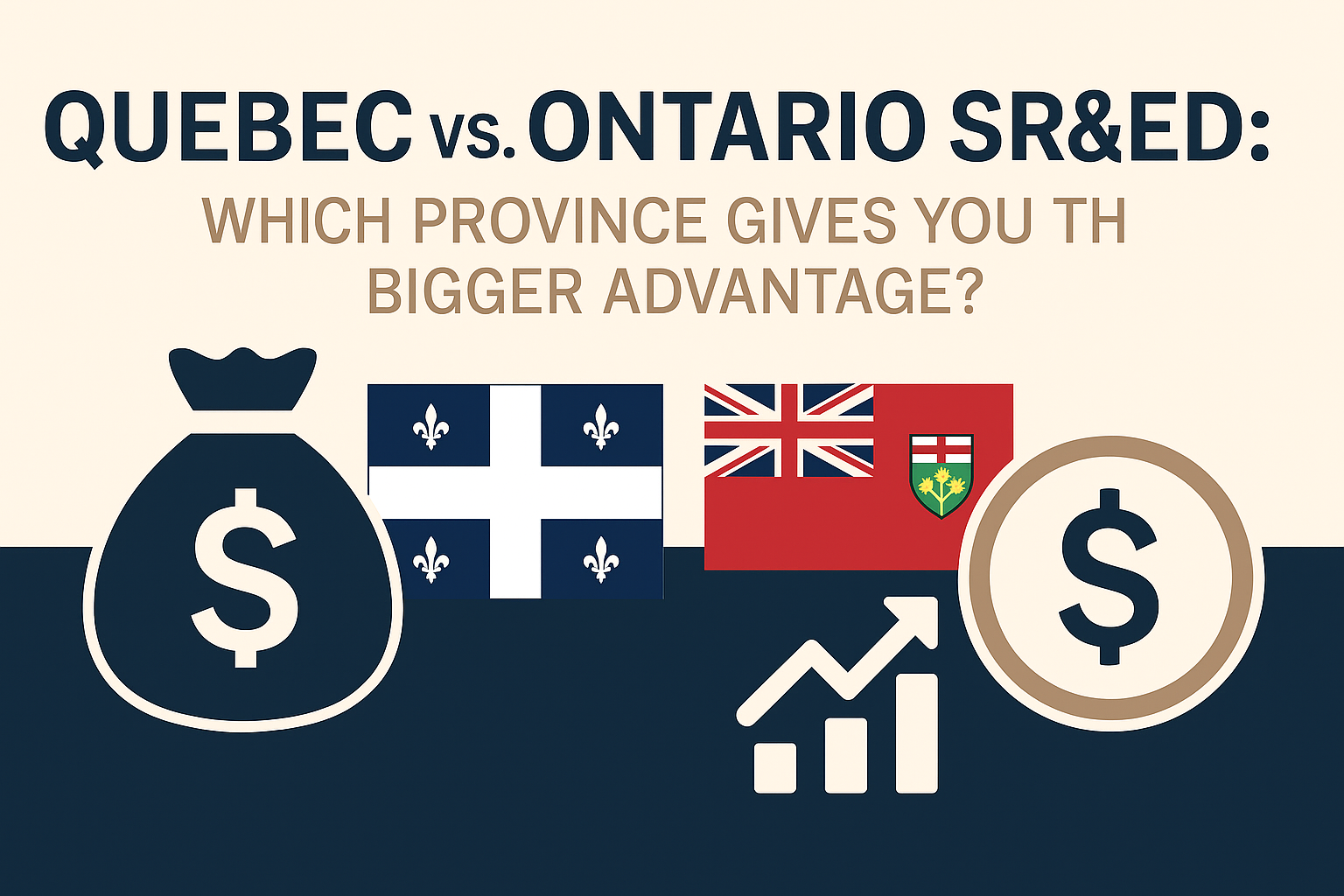
The Scientific Research & Experimental Development (SR&ED) program is one of Canada’s most generous R&D tax credit systems. Both Quebec and Ontario offer lucrative federal and provincial incentives, but the structure, rates, and eligibility requirements vary between the provinces. Understanding these differences is essential for businesses seeking to maximize SR&ED refunds and improve cash flow.
In this guide, we’ll compare Quebec vs. Ontario SR&ED programs in detail, helping you decide which province provides the bigger advantage for your innovation investments.
What Is SR&ED and Why Does Province Matter?
The federal SR&ED program provides refundable and non-refundable tax credits for eligible R&D expenditures. Provincial governments add their own supplemental incentives, which can significantly impact your total refund.
The province where R&D activities take place determines which credits you can claim. Therefore, a business operating in Quebec may qualify for higher provincial credits compared to Ontario, but with different compliance and documentation requirements.
To understand the basics of SR&ED eligibility criteria, check the full SR&ED guide.
Quebec SR&ED Tax Credits Overview
Quebec is widely known for its generous SR&ED refundable tax credits, especially for startups and SMEs. The province offers multiple incentives through Revenu Québec, including:
- Refundable Tax Credit for R&D Salaries (R&D ITC) – Up to 30% refundable credit for eligible salaries and wages, with enhanced rates for small businesses.
- Additional Credits for Pre-Competitive Research & University Partnerships – Businesses collaborating with public institutions may receive extra incentives.
- Credit Rates Based on Size and Activities – Smaller businesses can access higher refundable rates, while larger corporations benefit from significant deductions.
Quebec’s system is highly favorable for labor-intensive R&D projects, such as software development, biotech, and clean technology.
If your project involves scientific or technological uncertainty, you may benefit from Quebec’s flexible interpretation of qualifying work. For tips on documenting uncertainty effectively, see this guide on SR&ED documentation.
Ontario SR&ED Tax Credits Overview
Ontario also provides strong SR&ED incentives, primarily through:
- Ontario Innovation Tax Credit (OITC) – A refundable credit of 3.5% on eligible R&D expenses for Canadian-controlled private corporations (CCPCs).
- Ontario Research and Development Tax Credit (ORDTC) – A non-refundable credit of 3.5%, which can be carried forward to future years.
- Ontario Business Research Institute Tax Credit (OBRITC) – An additional 20% refundable credit for eligible expenditures in partnership with approved research institutes.
Ontario’s SR&ED add-ons are designed to support both small and large businesses, particularly those collaborating with universities and research centers. For a detailed breakdown, see Ontario SR&ED tips and add-ons.
Quebec vs. Ontario: Key Differences in SR&ED Benefits
While both provinces provide substantial support, there are key differences that could make one jurisdiction more beneficial than the other:
1. Refundable vs. Non-Refundable Credits
- Quebec: Offers higher refundable credits, even for larger companies. Refundable credits are paid out even if your company has no tax payable.
- Ontario: Refundable credits mainly target SMEs (through OITC and OBRITC), while larger firms rely on non-refundable credits.
2. Rate Structures
Quebec’s SR&ED salary credit rates are generally higher than Ontario’s. For SMEs, the advantage is particularly significant.
3. Industry-Specific Benefits
Quebec provides enhanced credits for IT, biotech, and collaborative research, whereas Ontario offers extra credits for projects involving approved research institutions.
4. Administrative Complexity
Quebec has more complex reporting and auditing processes. Ontario tends to align more closely with federal CRA standards, making the filing process simpler.
For an overview of how to coordinate federal and provincial R&D incentives effectively, refer to this guide on harmonizing SR&ED credits.

Which Province Offers the Bigger Advantage?
The best province depends on your business profile and R&D structure:
- Startups and SMEs with high R&D payroll – Quebec’s refundable credits often lead to larger immediate refunds.
- Companies working with universities – Both Quebec and Ontario provide strong support, but Ontario’s OBRITC can be highly lucrative.
- Large corporations with taxable income – Ontario’s combination of refundable and non-refundable credits can be valuable over time.
- Businesses with multiple locations – You can strategically allocate R&D activities across provinces to maximize total credits.
If you are unsure whether your project qualifies or which province yields a greater refund, use the SR&ED Calculator to estimate your potential credits.
Documentation and CRA Audit Considerations
Regardless of the province, CRA audit readiness is crucial. Both Quebec and Ontario require detailed technical narratives and financial records.
To avoid costly rejections:
- Maintain contemporaneous documentation of experiments and technological uncertainties.
- Keep payroll and expense records organized for easy verification.
- Understand provincial-specific audit procedures.
See best practices for SR&ED audits for a comprehensive guide.
How to Maximize Your SR&ED Refunds
To fully leverage SR&ED opportunities:
- Plan R&D budgets strategically – Consider provincial differences in rate and eligibility.
- Engage SR&ED experts – Professional consultants can optimize claims and reduce audit risks.
- Explore financing options – Many businesses leverage SR&ED financing to access funds before tax credit payouts.
- Stay updated on CRA policy changes – Rules evolve, and compliance is critical.
For personalized advice, explore SR&ED consulting services to ensure you are claiming every eligible dollar.
External Factors Influencing SR&ED Benefits
Beyond provincial differences, other factors affect SR&ED claim size:
- Federal SR&ED changes – For recent CRA updates, refer to Government of Canada SR&ED guidelines.
- Economic development programs – Quebec and Ontario offer additional innovation grants and loans that complement SR&ED (e.g., NRC IRAP).
An excellent resource for Canadian innovation policies is Innovation, Science and Economic Development Canada, which outlines complementary programs that can boost your R&D funding.
Conclusion: Quebec vs. Ontario – Which Should You Choose?
Both Quebec and Ontario offer substantial SR&ED advantages, but the optimal choice depends on your company size, industry, and R&D structure. Quebec’s higher refundable credits often favor startups, while Ontario provides flexible credits and research partnerships for growing companies.
The best strategy is often to analyze your specific projects, consult SR&ED experts, and ensure proper documentation to maximize your credits.
For tailored advice on your business’s unique situation, contact our SR&ED consultants today and discover how to optimize your R&D tax benefits.
