
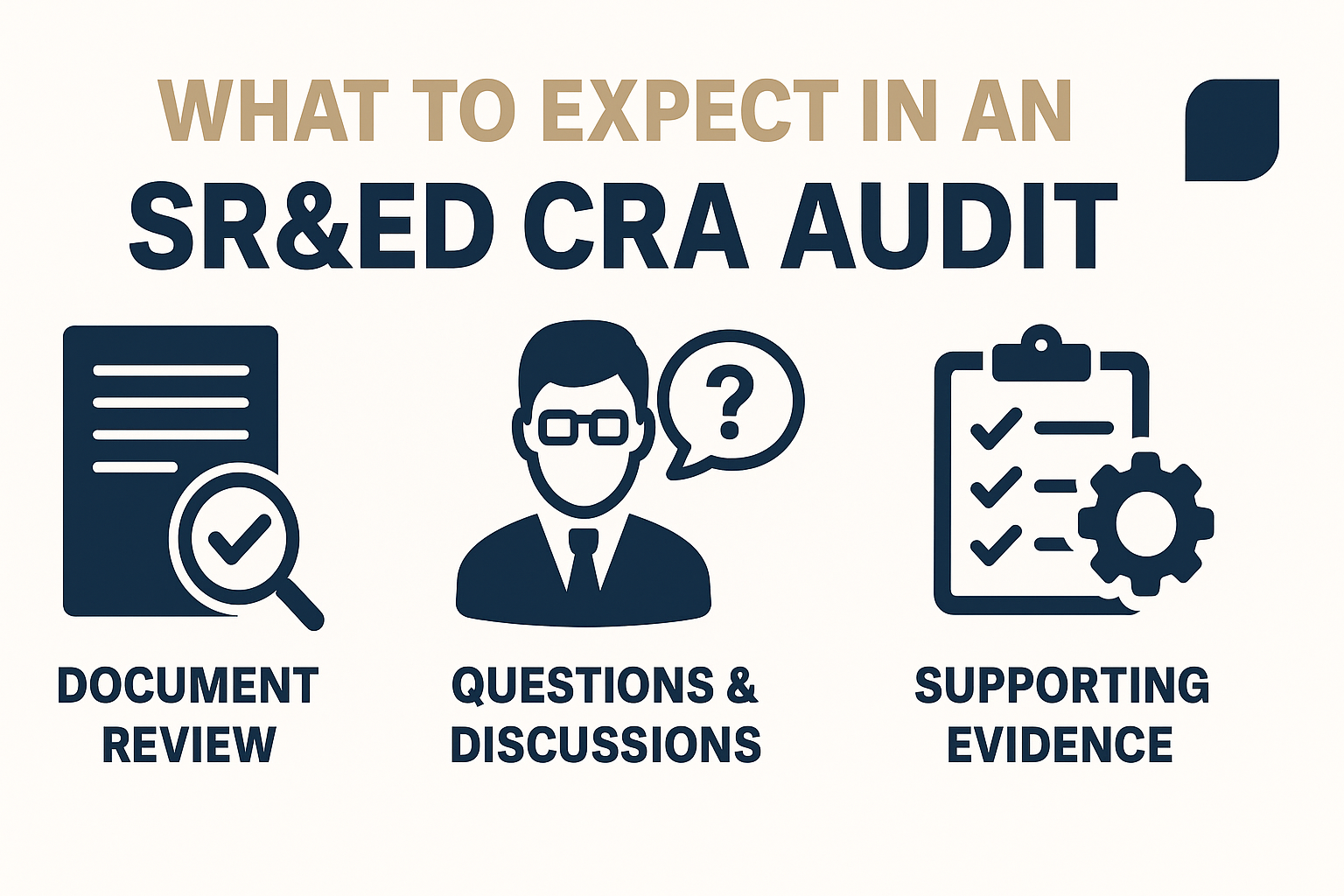
When a company files for Scientific Research & Experimental Development (SR&ED) tax credits in Canada, the Canada Revenue Agency (CRA) may conduct an audit to verify eligibility, expenses, and supporting documentation. Understanding the process, knowing what CRA auditors look for, and preparing the right evidence can be the difference between a successful claim and costly adjustments. Below is a complete, in-depth guide to navigating an SR&ED CRA audit effectively.
Understanding the Purpose of an SR&ED CRA Audit
An SR&ED CRA audit is designed to verify that the work being claimed meets the criteria set under the Income Tax Act and CRA’s Eligibility of Work for SR&ED policy. CRA auditors review whether:
- The project involved systematic investigation or search through experimentation or analysis.
- There was a technological or scientific uncertainty being resolved.
- Proper documentation and records support the claim.
- The claimed expenditures, such as salaries, subcontractor costs, and materials, are eligible.
For companies new to SR&ED or those with larger or unusual claims, audits are more common. A strong understanding of SR&ED eligibility can significantly reduce audit risk.
Types of CRA SR&ED Reviews
Technical Review
CRA’s Research and Technology Advisors (RTAs) evaluate the technical merit of your projects, ensuring they align with SR&ED requirements. They may:
- Request detailed descriptions of experiments, prototypes, and testing procedures.
- Interview technical staff involved in the R&D.
- Verify that the work addresses a genuine technological uncertainty and is not just routine engineering.
Financial Review
Financial auditors examine all costs submitted, ensuring they meet CRA’s strict guidelines. This includes reviewing:
- Payroll records, time tracking, and contractor invoices.
- Capital and material expenditures claimed.
- Allocation of overhead costs.
Many businesses turn to an SR&ED consultant to help prepare financial evidence and avoid common pitfalls, such as misclassifying non-eligible expenses.
How CRA Selects Files for Audit
CRA does not audit every SR&ED claim. Selection may be based on:
- Claim size and complexity – Large or first-time claims attract more scrutiny.
- Inconsistencies or missing details – Poor documentation or vague project descriptions increase audit likelihood.
- Previous compliance issues – Prior disallowed claims or penalties trigger closer reviews.
To minimize risk, companies should maintain detailed SR&ED project records throughout the year, as outlined in CRA’s official SR&ED Guidance.
What CRA Auditors Typically Request
During the audit, CRA typically asks for:
- Detailed project descriptions showing the scientific method or experimental process.
- Time-tracking logs for all employees involved in SR&ED.
- Documentation of technological uncertainties and hypotheses tested.
- Financial records including invoices, payroll, and material costs.
- Proof that claimed expenditures were necessary for the SR&ED activities.
Companies who utilize CRA’s SR&ED calculator in advance can ensure their claims align with eligible cost structures before filing.
Common Issues That Trigger Denials
Several issues can result in reduced or denied claims, including:
- Lack of contemporaneous documentation to prove experiments took place.
- Claims based on routine data collection, market research, or standard engineering work.
- Overstated overhead allocations or inclusion of ineligible expenses.
- Poorly articulated project descriptions that fail to highlight the scientific challenge.
Businesses often avoid these issues by working with experienced consultants and referencing guides such as Step-by-Step SR&ED Claim Process in Ontario.
Best Practices for Preparing for an SR&ED Audit
1. Maintain Detailed Records Throughout the Year
Auditors value detailed, real-time documentation, including:
- Lab notes, design schematics, and test results.
- Employee time logs and task breakdowns.
- Emails, meeting notes, and reports that prove systematic investigation.
Keeping records aligns with CRA’s recommendations and helps substantiate claims without scrambling to compile evidence later.
2. Separate Eligible and Non-Eligible Work Clearly
Ensure expenses tied to non-R&D work, such as routine production or commercial activities, are excluded. This prevents delays and disputes during financial reviews.
3. Involve Technical Personnel in Audit Preparation
CRA auditors often interview staff directly. Preparing your engineers, scientists, and developers to explain the project’s scientific or technological uncertainty can help defend your claim.
4. Consult a Professional Before Filing
Professional advisors can identify risk areas and prepare claims that withstand CRA scrutiny. They can also assist with SR&ED financing options if an audit delays your refund.
What Happens During the Audit
- Initial Notification – CRA informs you of the audit and specifies whether it’s a technical review, financial review, or both.
- Information Request – You’ll receive a list of required documents, often with a short deadline.
- On-Site Visit or Virtual Meeting – CRA may interview your staff, review facilities, and examine prototypes or test results.
- Assessment and Decision – CRA issues findings, which may approve, adjust, or deny parts of your claim.
- Opportunity to Respond – If CRA intends to disallow items, you can submit additional evidence before a final assessment.
Dealing with Disputes
If you disagree with CRA’s findings:
- Submit additional documentation to address concerns.
- Request a second-level review from CRA’s Appeals Division.
- As a last resort, consider filing a notice of objection or appealing to the Tax Court of Canada.
Detailed guidance is available through official CRA SR&ED Resources.
Conclusion: Preparing for Success
An SR&ED CRA audit doesn’t have to be daunting if you are well-prepared. Keeping meticulous documentation, understanding what CRA auditors expect, and consulting professionals can help ensure your claim is processed smoothly and fully. Companies that follow structured processes not only secure their tax credits faster but also reduce the likelihood of costly disputes.
For tailored support and guidance on preparing your claim and defending it during an audit, reach out through our Contact Page.