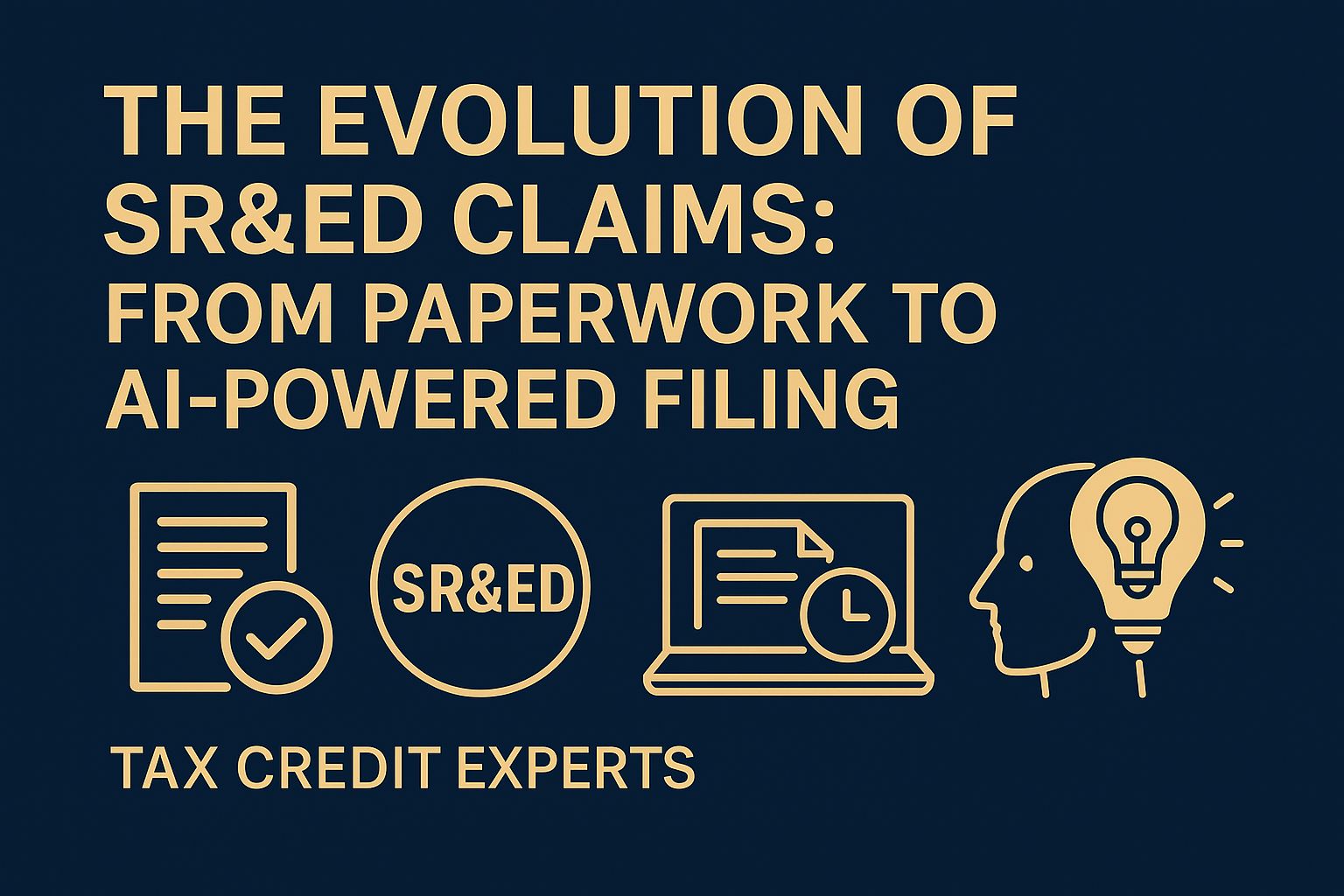
Scientific Research and Experimental Development (SR&ED) claims have long been a cornerstone of Canada’s innovation ecosystem, rewarding businesses that invest in research and development. What began as a paperwork-heavy, compliance-driven process has undergone a dramatic transformation in the past two decades. Today, artificial intelligence (AI), automation, and digital recordkeeping are redefining how Canadian businesses approach SR&ED filings, making the process faster, more accurate, and more strategic.
In this article, we’ll trace the journey of SR&ED claims from traditional paper submissions to today’s AI-powered platforms, examine the challenges along the way, and explore what the future holds for innovation funding in Canada.
The Early Days of SR&ED Claims
When the SR&ED program was first introduced, filing a claim was a highly manual exercise. Businesses needed to:
- Collect physical receipts, invoices, and payroll records.
- Maintain detailed lab notebooks and written project reports.
- Compile binders full of evidence to satisfy Canada Revenue Agency (CRA) auditors.
For many companies, especially startups and SMEs, the administrative burden overshadowed the financial benefits. This reliance on manual paperwork often led to incomplete submissions, missed deadlines, or rejections due to inadequate documentation.
While the program was designed to support innovation, the process itself discouraged smaller firms that lacked dedicated tax or R&D departments.
The Shift to Digital Recordkeeping
By the early 2000s, businesses began moving away from filing cabinets and toward digital systems. Tools like spreadsheets, databases, and online portals offered new ways to organize and track eligible expenses.
This transition marked the first major step toward efficiency:
- Electronic submissions reduced delays in processing claims.
- Cloud storage allowed multiple stakeholders to collaborate.
- Digital time-tracking software replaced manual logs, reducing human error.
Still, digital recordkeeping came with challenges. Many businesses did not know how to properly track scientific and technological uncertainty, a key eligibility criterion under SR&ED. As a result, companies often turned to experts for guidance. If you’re struggling to determine eligibility, see this comprehensive guide on SR&ED eligibility.
The Role of SR&ED Consultants in the Digital Age
As digital systems became common, a new industry of SR&ED consultants emerged. These professionals specialized in interpreting CRA requirements, writing technical narratives, and maximizing claim value.
Their role included:
- Identifying overlooked eligible expenses.
- Advising on proper documentation practices.
- Defending claims during CRA audits.
Today, consultants remain essential partners. But even their work is being reshaped by AI-powered tools. Many top consultants now use intelligent platforms to analyze R&D projects and generate claims more efficiently. For insight into how consultants add value, explore the role of a SR&ED consultant.
The AI Revolution in SR&ED Filing
The most significant shift in SR&ED filing is happening now: the rise of AI-powered platforms. These technologies streamline nearly every aspect of claim preparation:
1. Automated Expense Tracking
AI integrates with payroll and accounting systems to automatically flag eligible R&D expenses, reducing the risk of human error.
2. Smart Documentation Tools
Machine learning algorithms can analyze project notes, emails, and code repositories to extract relevant evidence of scientific uncertainty and experimental progress.
3. Predictive Claim Modeling
AI platforms can estimate potential refund amounts in real time, allowing businesses to forecast cash flow more accurately. Businesses can also explore traditional tools like the SR&ED calculator to project returns.
4. CRA Audit Readiness
Some AI systems compare claim narratives against CRA audit trends, highlighting weak points before submission. This ensures businesses are better prepared if their claim is reviewed.

Benefits of AI-Powered SR&ED Filing
The integration of AI brings tangible advantages for Canadian businesses:
- Time savings: Automating repetitive tasks frees up management and R&D staff.
- Higher accuracy: AI reduces the chance of missing expenses or providing insufficient documentation.
- Improved compliance: Algorithms are trained to align with CRA’s evolving guidelines.
- Strategic planning: Predictive insights help companies plan R&D budgets more effectively.
For businesses seeking upfront liquidity, combining AI insights with funding options like SR&ED financing can unlock capital even before refunds arrive.
Challenges of the AI Transition
Despite the benefits, businesses adopting AI-powered SR&ED tools must be aware of potential challenges:
- Data Privacy: Sensitive R&D information must be protected under Canadian privacy laws.
- Over-Reliance on Automation: AI may misinterpret nuanced technical narratives without human oversight.
- Costs of Implementation: Advanced platforms may be out of reach for smaller firms without additional support.
Ultimately, AI should complement—not replace—the expertise of skilled professionals. Balancing automation with human judgment remains critical.
How the CRA Responds to AI in SR&ED
The CRA has recognized the rise of digital and AI tools in SR&ED claims. While they have not issued AI-specific guidelines, they continue to emphasize:
- Proper documentation of uncertainty and experimentation.
- Clear technical narratives written in human language.
- Audit readiness regardless of the filing method.
In fact, CRA audit practices are evolving to include digital audits, where businesses are asked to provide direct access to electronic records rather than submitting paper binders. For a detailed view of CRA audit practices, read more about what to expect in an SR&ED CRA audit.
The Future of SR&ED Filing in Canada
Looking ahead, SR&ED filing is expected to become even more integrated with AI and data-driven systems. Key trends include:
- End-to-End AI Platforms: From project tracking to filing, systems will handle claims seamlessly.
- Integration with Government Systems: Direct links between business accounting platforms and CRA portals will reduce manual uploads.
- Enhanced Transparency: Businesses will have real-time dashboards showing refund estimates and claim status.
- Global Expansion: As other countries adopt R&D tax incentives, Canadian AI filing platforms may find international markets.
For Canadian businesses, embracing these trends will not only maximize tax credits but also strengthen long-term innovation strategies.
Conclusion: From Paperwork to Predictive Filing
The evolution of SR&ED claims is a story of transformation—from binders of paper to AI-powered platforms that anticipate CRA requirements. Businesses that adapt to these changes are positioned to maximize refunds, improve compliance, and strengthen their innovation funding strategies.
Whether you are a startup documenting your first project or a large enterprise with multiple R&D streams, the key to success lies in combining intelligent automation with expert guidance. If you’re ready to modernize your SR&ED strategy, connect with experts through the Contact page today.